
Product Cybersecurity Regulation
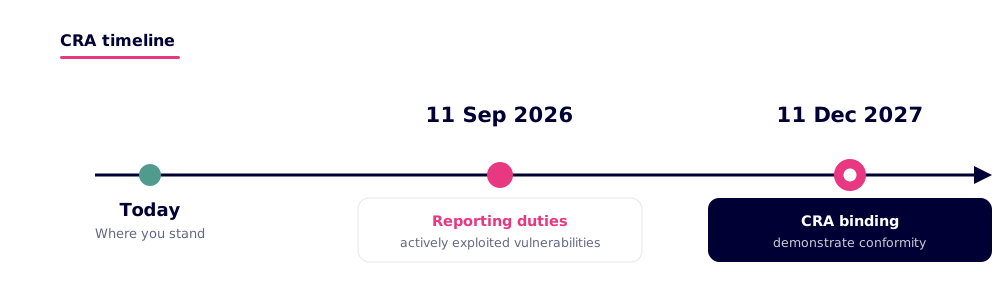
From 11 Dec 2027, there is no CE marking without the CRA. If you cannot demonstrate conformity with the Cyber Resilience Act, the RED Delegated Act and the Machinery Regulation by then, you lose the CE mark and with it access to the EU market.
What is at stake
The question is no longer whether the CRA and the regulations alongside it apply to your products. It is what market surveillance finds when it looks. There is no transition regime that tolerates gaps in your technical documentation, and the later the gaps surface, the more expensive they are to close.
Loss of market access
Without proof of conformity, your product can no longer be placed on the EU market. No sales, no servicing, no updates.
Recall & sales stop
Market surveillance can prohibit making the product available, order a recall, or have it withdrawn from the market.
Fines up to €15M
The CRA provides for fines up to €15 million or 2.5% of global annual turnover, on top of regulatory action.
Exclusion from tenders
Customers increasingly require CRA and IEC 62443 evidence as an entry criterion. Without it, you are screened out early.
Typical Challenges
These patterns recur across manufacturers. The more of them apply to your situation, the more urgent a structured assessment becomes, before deadlines, effort and bottlenecks collide.
Unclear scope
Which regulation applies to which product? The CRA, the RED Delegated Act and the Machinery Regulation overlap, and the legal text never says what that means for your product.
Standards maze
EN 40000, EN 50742, EN 18031, IEC 62443: mapping the right harmonized standards drives the effort, yet the right choice is rarely obvious.
Missing evidence
Technical documentation, risk assessment and declaration of conformity are missing or fail to hold up under market surveillance and notified bodies.
No demonstrable SDLC
The CRA requires a documented secure development lifecycle. Building one retroactively under time pressure ties up engineering capacity you need elsewhere.
Reporting duties from 2026
Reporting duties for actively exploited vulnerabilities apply from 11 Sep 2026. Without a process in place, missed deadlines carry liability.
No internal resources
Product security is rarely staffed as a dedicated role. The responsibility spreads across teams that are already at capacity.
How Secuvise helps
From legal text to audit-ready conformity
You know what the EU requires. What the legal text leaves out is what that means in your architecture, your code and your processes.
That is exactly where we start. We translate the requirements into what your engineering team actually has to do, and deliver evidence that holds up with notified bodies.
Regulation and engineering under one roof
We connect the CRA, RED Delegated Act and Machinery Regulation with technical implementation in the product. That removes friction between compliance, engineering and management.
Depth in the harmonized standards
EN 40000, EN 50742, EN 18031, IEC 62443: we know the standards that decide your effort and map them precisely to your products.
Security that sits in the product
We implement security requirements technically in the product, not just in documentation, from architecture and cryptography to secure boot.
Built for test labs and notified bodies
Our evidence is geared to conformity assessments, audits and certifications, including coordination with the bodies involved.

Our Approach
Four steps that hold up with assessors
Cybersecurity for products cannot be solved with isolated measures. Our approach takes you from scoping to demonstrated conformity in a way that anyone can follow.
Surface the gap
We assess your product against the applicable requirements, both technically and procedurally, and identify the missing processes, security activities and evidence.
Set the roadmap
We weigh effort, risk and regulatory relevance and build an actionable plan across product, engineering and organization.
Steer the implementation
We support delivery in day-to-day engineering, from design decisions and secure development processes to vulnerability and supplier management.
Prove conformity
We prepare and accompany the conformity assessment, audit and certification, so the results also carry over to later product versions.
Your Deliverables
In the end you are left not just with documents, but with a conformant product and an organization that can sustain that conformity.
Clarity & plan
The basis for every conformity decision: a solid assessment and a prioritized plan.
- Scoping & gap analysis with deviations named in concrete terms
- Standards mapping (EN 40000, EN 50742, EN 18031, IEC 62443)
- Compliance roadmap with milestones and an effort estimate
Evidence & documentation
The records that stand up to market surveillance and notified bodies, and carry over to later versions.
- Technical documentation per regulatory requirements
- Declaration of conformity (DoC) and evidence trail
- Preparation for market surveillance and regulatory inspection
Conformant product & organization
The actual goal: a product that meets the requirements, and an organization that keeps it that way.
- CRA-conformant product with a solid CE basis
- An established secure development lifecycle
- Product-security processes anchored internally
- Transferable to follow-up products and versions
Who this service is for
This service is for manufacturers whose products with digital elements fall under the CRA and often parallel regulation, from mid-sized firms to large enterprises.
Machinery & plant builders
Manufacturers whose products fall under both the CRA and the new Machinery Regulation and need both sets of evidence.
Embedded & IIoT
Makers of connected devices and components with digital elements that need to secure their access to the EU market.
Manufacturers without their own product security function
Companies without a dedicated product security team that have to connect regulatory requirements to technical reality.
What our clients say about us
We faced the challenge of making our entire mobile robots portfolio EN 18031-conformant under significant time pressure. Secuvise did not just advise us, they supported us hands-on, from systematically gathering information to the gap analysis and running the conformity tests. Without that pragmatic support, we would not have met our deadline.
For the regulatory conformity of our products we needed a partner who combines technical depth with practical feasibility. Working with Secuvise was straightforward and the solutions fit well into our development.
Frequently asked questions
When does the CRA become binding?
The core obligations of the Cyber Resilience Act apply from 11 Dec 2027. The reporting duties for actively exploited vulnerabilities and serious security incidents already apply from 11 Sep 2026. If you sell products with digital elements, plan the remaining time for analysis and implementation.
Does the CRA apply to my product?
The CRA covers products with digital elements, meaning hardware and software that can connect directly or indirectly to a device or network. In practice, most connected products fall within scope. In the scoping analysis we establish precisely which requirements apply to your specific product.
How do the CRA, RED Delegated Act and Machinery Regulation relate?
The three frameworks place partly overlapping cybersecurity requirements on different product categories. We establish which regulation is the lead one for your product and map the right harmonized standards, so you meet requirements once instead of assessing them several times.
Do we always need a notified body?
That depends on the product category. Self-assessment is foreseen for a share of products, while critical products require a notified body. We prepare your evidence so that it holds up for either route, and we support the coordination with test labs and notified bodies.
How quickly can we become conformant?
The pace depends on your starting point. After the gap analysis you get a realistic roadmap with an effort estimate. The earlier you start, the more room you keep to close gaps without last-minute audit loops.
Did not find the answer you need?
Talk to us. We will answer it for your product and the regulation that applies to it, not in general terms.
Book a callGet in touch
Ready to check your CRA status?
Want to know which cybersecurity requirements apply to your products, and what it takes to meet them in engineering and in your processes? In a short call we go through your product, name your biggest compliance risks, and lay out what to do next.
Book a free initial call
Fill in the form. We will get back to you shortly to arrange a short initial call.