
Find the weaknesses before anyone else does
For CRA conformity and IEC 62443-4-2, documented security testing is mandatory. Without it, the evidence is missing, and whatever you have not tested becomes an attacker's way in once the product is in the field.
What is at stake
Every product has an attack surface. The only question is who finds it first: you in a controlled test or an attacker in the field. Left untested, it stays a risk you cannot put a number on.
Undetected vulnerabilities
What you do not test, attackers or market surveillance will find, at a far worse moment.
No proof of conformity
Without documented testing, the evidence for the CRA and IEC 62443-4-2 is missing.
Incident instead of update
An exploited gap in the field becomes a reporting and crisis case instead of a planned patch.
Loss of trust
Security incidents in shipped products cost trust with customers and partners.
Typical Challenges
These patterns mean vulnerabilities are found too late or not at all. The more of them apply to you, the larger the residual risk in your product.
Blind spots in the product
No one knows every attack surface of their own product. Interfaces and firmware in particular go unchecked.
Testing without a method
Ad-hoc tests without a structured methodology produce no solid, repeatable evidence.
Embedded is different
Firmware, hardware and industrial protocols cannot be tested with standard web tools.
Reports without prioritization
Long lists of findings without a risk rating do not help the development team.
No testing capacity in-house
Specialized security testing is rarely available internally and ties up scarce know-how.
One test is not enough
Every significant product change creates new vulnerabilities. Testing once is not enough.
How Secuvise helps
Structured tests, solid evidence
A good test does not find just anything, it finds what matters. We test in a structured way, document traceably and prioritize by real risk.
Our reports are built so your development team can work with them directly and the evidence holds up with assessors and audits.
A structured testing methodology
We test to recognized methods, compliant with ISO/IEC 17025, IEC 62443 and ISO/IEC 27034, traceable and repeatable.
Depth in embedded and industry
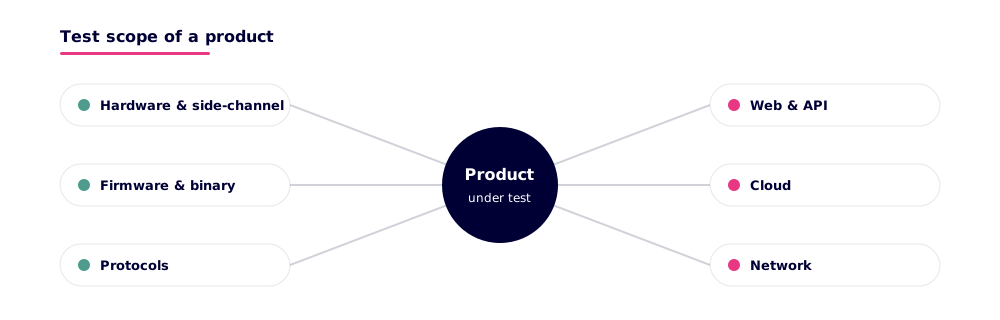
We test IoT devices, embedded systems and industrial components, including firmware, binary and protocol analysis.
Web, API and network
We test web applications (per OWASP), APIs, cloud connections and networks, through to physical attacks.
Prioritized findings
You receive reports with CVSS ratings, business impact and root cause, plus concrete, actionable recommendations.

Our Approach
Four steps to solid tests
A meaningful test needs the right frame. Our approach runs from an agreed scope through execution to re-tested remediation.
Scoping
We define test objectives, attack surfaces and methodology, matched to your product and evidence needs.
Test
We run the tests: hardware, firmware, communication, web, API and more, depending on scope.
Assess & report
We rate every vulnerability by CVSS and add business impact and root cause, so you can weigh technical and business risk correctly.
Secure the fixes
We prioritize the measures with your team and re-test every fix until the vulnerability is verifiably closed.
Your Deliverables
You walk away with more than a list of findings: a clear picture of your product's security and the evidence to prove it.
A clear test scope
The basis of any solid test: knowing what is tested and how.
- Defined test scope & attack surfaces
- Methodology compliant with ISO/IEC 17025, IEC 62443, ISO/IEC 27034
- Matched to product and evidence needs
A solid vulnerability report
A report your team can work with directly, set in both technical and business terms.
- Detailed vulnerability descriptions
- Technical rating (CVSS) and business impact
- Root-cause analysis per finding
- Concrete, prioritized recommendations
Demonstrated product security
The actual goal: a product that has been tested and provides the evidence for it.
- Documented proof for the CRA and IEC 62443-4-2
- Fixed and re-tested vulnerabilities
- Resilient against real attack scenarios
- A basis for audit and certification
Who this service is for
This service is for manufacturers that need to prove their product security or de-risk it before the audit.
Embedded & IoT makers
Manufacturers that need to have devices and components tested before market launch.
Industrial & component makers
Providers that need documented security testing for IEC 62443-4-2.
Manufacturers before audit or release
Teams that want to find vulnerabilities before assessors or attackers do.
What our clients say about us
We faced the challenge of bringing our entire mobile robot portfolio into EN 18031 compliance under significant time pressure. Secuvise did not just provide advice, but actively supported us hands-on, from structured information gathering and gap analysis through to executing conformity testing. Without this pragmatic support, we would not have met our deadline.
Secuvise has always supported us closely and reliably in developing our security concepts. The collaboration has been consistently constructive and collegial, exceeding our expectations. I look forward to continued partnership across all areas of cybersecurity.
Frequently asked questions
What is a penetration test?
A penetration test is a controlled, expert-led attack on your product that replays real attack scenarios. The goal is to find and rate vulnerabilities before a real attacker or an assessor does, and to deliver concrete recommendations for fixing them.
What methods do you test to?
We test in a structured and traceable way, compliant with ISO/IEC 17025, IEC 62443 and ISO/IEC 27034. That methodology makes the results repeatable and keeps the evidence holding up in assessments and audits.
Do you also test embedded systems and hardware?
Yes, that is our focus. We test IoT devices, embedded systems and industrial components, including firmware and binary analysis, protocol and network testing, and physical attacks such as side-channel analysis.
Do I need penetration testing for the CRA or IEC 62443?
For CRA conformity and IEC 62443-4-2, documented security testing is mandatory. For the regulatory framework, see CRA & Product Regulation, and for certification, Approval & Certification.
How often should we test?
A test is a snapshot. With every significant product change, new interface or major firmware version, the affected areas should be tested again. We help you define sensible test points across the product lifecycle.
Did not find the answer you need?
Talk to us. We will answer it for your product and the testing you need, not in general terms.
Book a callGet in touch
Ready to test your product security?
Want to know where your product can be attacked, and have test evidence that holds up for the CRA and IEC 62443? In a short call we work out the test objectives and the attack surface, and scope the testing that fits.
Book a free initial call
Fill in the form. We will get back to you shortly to arrange a short initial call.