
Product security with a clear owner
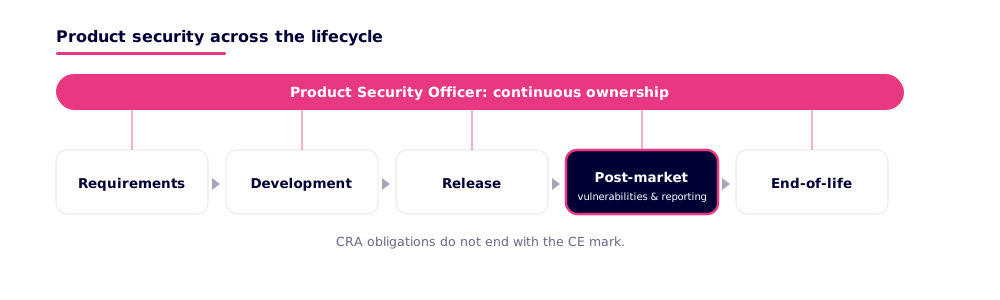
CRA obligations do not end with the CE mark: vulnerability handling, reporting duties, updates and post-market surveillance run for years. Without a clear owner, product security falls between teams, and gaps surface at the worst possible time.
What is at stake
Product security is not a project with an end date, it is an ongoing job. As long as no one owns it, it stalls, until an incident, a reporting deadline or an audit forces it.
No one is responsible
Without a clear role, product security falls between development, quality and management, and slips through the cracks.
Missed reporting deadlines
The CRA reporting duties have tight deadlines. Without a process and an owner, missed deadlines carry liability.
Vulnerabilities left open
Reported or known vulnerabilities sit unaddressed until they are exploited in the field.
Reactive, not steered
Without a roadmap, product security is driven by incidents instead of being planned and steered.
Typical Challenges
These patterns leave product security orphaned, with no clear owner. The more of them apply to you, the more you need a person to lead it.
No dedicated role
Product security is no one's main job and regularly slips in day-to-day work.
Uncoordinated activities
Requirements, testing, vulnerabilities and reports run side by side without central steering.
Unclear reporting duties
Who reports what to whom, and by when? Without a fixed process, that is a liability risk.
No vulnerability process
Incoming vulnerability reports are not assessed and handled systematically.
Post-market underestimated
The obligations after market launch tie up resources permanently that no one planned for.
Full-time role not justified
There is not enough load for a dedicated PSO position. The task remains anyway.
How Secuvise helps
One owner for your product security
As your external Product Security Officer, we take strategic and operational responsibility for the cybersecurity of your products and take the load off your own team.
You keep control, we take operational responsibility and create structures that keep working after we step out.
Strategy and roadmap
We develop a product-security roadmap and steer the security program across the entire lifecycle.
Central coordination
We coordinate all security activities, from requirements to end-of-life, including vulnerability response and post-market surveillance.
Vulnerabilities and reporting duties
We run vulnerability management, coordinate security patches and meet reporting and response obligations.
Capability, not dependency
Unlike a classic interim manager, we work with you long-term and deliberately build up your own security capability.
Our Approach
Four steps to owned product security
Ownership is not taken on overnight. Our approach runs from taking stock through ongoing steering to building your own competence in-house.
Take stock
We map products, obligations and existing security activities and find the open responsibilities.
Roadmap & processes
We define the roadmap, roles and processes for vulnerabilities, reporting and updates.
Take operational ownership
We take operational responsibility: coordination, vulnerability response, reporting duties and stakeholder communication.
Build capability
We anchor structures and enable your team so product security holds even after we step out.
Your Deliverables
You walk away with more than advice: someone who actually owns product security, and a structure that lasts.
Strategy & clear roles
Product security is planned and assigned to an owner.
- A product-security roadmap
- Defined roles & responsibilities
- Processes for vulnerabilities, reporting and updates
Ongoing operation
The obligations after market launch are met reliably.
- Vulnerability management & patch coordination
- Reporting and response obligations met
- Continuous monitoring of threats & compliance
Anchored product security
The actual goal: product security that is owned and holds in-house.
- Central ownership of product security
- CRA post-market obligations met
- Your own security capability built up
- Structures that hold even after we step out
Who this service is for
This service is for manufacturers that need ongoing product security but cannot justify or staff a full-time role for it.
Teams without product security
Companies without a dedicated product-security function in-house.
Manufacturers with post-market obligations
Manufacturers that have to meet CRA obligations across the entire product lifecycle.
Growing security organizations
Companies that want to build internal competence instead of staying dependent on external help.
What our clients say about us
Secuvise has always supported us closely and reliably in developing our security concepts. The collaboration has been consistently constructive and collegial, exceeding our expectations. I look forward to continued partnership across all areas of cybersecurity.
For regulatory compliance of our products, we needed a partner who combines technical depth with practical implementability. Working with Secuvise was straightforward, and their solutions integrated well into our development process.
Frequently asked questions
What does a product security officer do?
A product security officer (PSO) owns the cybersecurity of a company's products across the entire lifecycle: from the strategic roadmap and the coordination of all security activities to vulnerability management, reporting duties and post-market surveillance. The PSO is the central point of contact for all product-security topics.
Why external instead of internal?
Many manufacturers have the need but not the workload for a dedicated full-time role, or cannot find the specialization on the market. As an external PSO we bring the role ready to go, take responsibility, and build internal competence in parallel, so the dependency decreases over time.
Do you take responsibility in ongoing projects?
Yes. We take operational responsibility for product security, coordinate the security activities and act as the point of contact for internal teams, customers and authorities. You keep strategic control; we make sure it runs operationally.
How does the PSO relate to the CRA?
The CRA requires not only a secure product but also ongoing obligations after market launch: vulnerability handling, reporting duties and updates across the entire lifecycle. These are exactly the obligations the PSO owns. For the regulatory framework, see CRA & Product Regulation.
How long does the engagement last?
Unlike a traditional interim manager, we work on a long-term basis. We take the role for as long as you need it externally, and at the same time build internal competence so you can take over the responsibility step by step.
Did not find the answer you need?
Talk to us. We will answer it for your product and how your organization is set up, not in general terms.
Book a callGet in touch
Ready to put product security in reliable hands?
Want someone to own product security without hiring for a full-time role? In a short call we go through what you need, which obligations are still open, and what an external PSO would look like for you.
Book a free initial call
Fill in the form. We will get back to you shortly to arrange a short initial call.