
Build cybersecurity into the product itself
The requirements of the CRA and IEC 62443 have to sit in the product technically, not in documentation. Without security engineering, gaps in architecture, cryptography or implementation turn into vulnerabilities and audit findings.
What is at stake
An attacker does not review your documentation, they probe your product. Whatever is not implemented cleanly in architecture, cryptography or access control becomes an attack surface, in testing, in the audit or in the field.
Vulnerabilities in the product
Gaps in architecture and implementation become exploitable vulnerabilities in the field, with reporting and update obligations.
Exposed interfaces
Unprotected communication, weak cryptography or missing access control open up attack surface.
Findings instead of a certificate
If security only exists on paper, it shows immediately in testing and audits and costs you the certificate.
Expensive remediation
Security flaws found late force redesigns and recalls instead of simple updates.
Typical Challenges
We see these technical gaps in products again and again. The more of them apply to you, the larger the attack surface that shows up in the audit or in the field.
Security only on paper
Security requirements are documented but not implemented in the product technically.
Cryptography used wrong
Key management, algorithms or protocols are insecurely chosen or incorrectly implemented.
Weak access control
Authentication and authorization are incomplete, too permissive or bypassable.
Unhardened embedded systems
Secure boot, firmware protection and hardening are missing or only partly in place.
Security not in the architecture
Security decisions are made late instead of shaping the architecture from the start.
Code risks undetected
Security-critical code is not reviewed systematically, neither manually nor with static analysis.
How Secuvise helps
Security anchored in the product
Good security starts in the architecture and ends in reviewed code. We implement the requirements technically, instead of only describing them.
Our security engineers work closely with your development teams and bring experience from embedded security, industrial control systems and IoT.
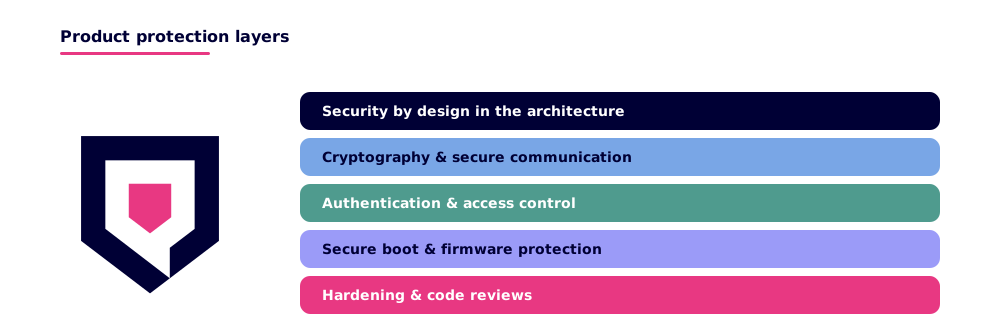
Security by design in the architecture
We derive security requirements from threat analyses (threat modeling per STRIDE or PASTA) and use them to shape the architecture.
Cryptography and secure communication
We advise on key management, algorithms and protocols and implement secure communication correctly.
Access control and hardening
We implement authentication, authorization and access control, including secure boot, firmware protection and hardening.
Code security reviews
We review security-critical code manually, complemented by automated static analysis (SAST).
Our Approach
Four steps to secure technology
Technical security does not happen by accident. Our approach runs from threat analysis through implementation to verification, closely interlocked with your development.
Analyze the threats
Through threat modeling we determine which attacks your product actually has to withstand.
Derive requirements
We derive concrete, technical security requirements and prioritize them by risk and effort.
Implement
We implement architecture, cryptography, access control and hardening in the product, closely with your team.
Verify
We check the implementation through architecture and code reviews, so the security holds up under attack.
Your Deliverables
You walk away with security that sits in the product: from a sound architecture and implemented protections to reviewed code.
Secure architecture & requirements
The basis: knowing what you protect against and how the product has to be built.
- Threat model per STRIDE or PASTA
- Derived, prioritized security requirements
- Documented secure-architecture decisions
Implemented protections
Security that is not described but implemented in the product.
- Cryptography & key management
- Authentication, authorization & access control
- Secure boot, firmware protection & hardening
Verified product security
The actual goal: a product that withstands real attacks and passes audits.
- Security-critical code reviewed (review & SAST)
- Security hardening guides
- Demonstrable for the CRA and IEC 62443
- Resilient against real attack scenarios
Who this service is for
This service is for manufacturers that need to implement cybersecurity in the product technically, not just describe it for compliance.
Embedded & device makers
Manufacturers that have to implement secure boot, cryptography and hardening directly in the product.
Industrial & ICS makers
Providers of connected components and controllers that have to withstand real attacks.
Teams without in-house security engineering
Development teams that have to implement regulatory requirements technically but lack the specialization in-house.
What our clients say about us
We faced the challenge of bringing our entire mobile robot portfolio into EN 18031 compliance under significant time pressure. Secuvise did not just provide advice, but actively supported us hands-on, from structured information gathering and gap analysis through to executing conformity testing. Without this pragmatic support, we would not have met our deadline.
For regulatory compliance of our products, we needed a partner who combines technical depth with practical implementability. Working with Secuvise was straightforward, and their solutions integrated well into our development process.
Frequently asked questions
What is security engineering?
Security engineering is the technical implementation of cybersecurity in the product: from secure architecture through cryptography, access control and hardening to code review. It turns regulatory requirements into a product that actually withstands attacks.
What is threat modeling per STRIDE or PASTA?
Threat modeling is a structured threat analysis. STRIDE and PASTA are established methods for systematically determining which attacks on a product are possible. From that we derive concrete, prioritized security requirements, instead of securing blindly.
How does security engineering relate to the SDLC?
The secure development lifecycle defines when security activities happen. Security engineering is the technical substance produced in those activities. More on the process under Secure Development Lifecycle.
Do you also implement the regulatory requirements?
Yes. We translate the requirements from the CRA and IEC 62443 into concrete technical measures in the product. For the regulatory framework, see CRA & Product Regulation, and for certification, Approval & Certification.
Do you work in embedded and ICS environments?
Yes. Our focus is embedded security, industrial control systems (ICS) and IoT. We know the constraints of these systems, from limited resources to long product lifecycles, and tailor the security measures to them.
Did not find the answer you need?
Talk to us. We will answer it for your product and its architecture, not in general terms.
Book a callGet in touch
Ready to bring security into the product?
Want the cybersecurity requirements built into the product properly, from architecture down to the code? In a short call we pin down where you stand technically, name the biggest gaps, and lay out what to do next.
Book a free initial call
Fill in the form. We will get back to you shortly to arrange a short initial call.