
Build security into your development process
The CRA and IEC 62443-4-1 require a documented, lived secure development lifecycle. Bolt security on at the end and you fail the audit and slow development down. Built retroactively and under time pressure, it gets expensive.
What is at stake
Product security cannot be pushed to the end of development. If the process is missing, it shows exactly when it is most expensive: just before release, in the audit, or after the first security incident.
No SDLC, no evidence
The CRA and IEC 62443-4-1 assume a demonstrable development process. Without it, there is no conformity and no certificate.
Expensive rework
Security that arrives late forces redesigns just before release and pushes dates back.
Vulnerabilities ship
Without security gates, avoidable flaws reach production and become a vulnerability and reporting case.
Security left to chance
Without an anchored process, product security depends on individuals and is not repeatable.
Typical Challenges
These patterns hold a solid development process back. The more of them you recognize, the more a structured look at your SDLC pays off.
Security bolted on at the end
Security is pushed to the end of development instead of running along from the start. That bites just before release.
Process does not fit the method
Whether waterfall, agile, DevOps or hybrid: an SDLC that ignores how you work gets bypassed instead of lived.
Missing security gates
Without defined review and approval points, there is no evidence that security was checked at all.
No vulnerability process
Vulnerability management and incident response are not established, even though the CRA requires exactly that.
Teams without a security routine
Development teams know security-by-design as the exception, not as a fixed part of their day.
Not demonstrable
Even existing security activities are not documented in a way that survives an audit.
How Secuvise helps
Security that belongs in the process, not on top of it
A good SDLC does not slow development down, it makes it more reliable. The key is to fit security into the way you already work, instead of placing a foreign body next to it.
We analyze how your teams actually ship and anchor security where it has an effect, matched to your product, method and regulatory requirements.
An SDLC that fits your method
We integrate security into waterfall, agile, DevOps or hybrid workflows without slowing development down.
Threat modeling and security gates
We anchor threat analyses, review gates and approval processes as fixed parts of development.
Vulnerability and update management
We establish vulnerability management and incident response as the CRA and IEC 62443 require.
Enabled teams
We train your development teams in security-by-design so the process holds even without us.
Our Approach
Four steps to a lived SDLC
A development process does not change overnight. Our approach takes you from an honest assessment of where you stand to an SDLC that works day-to-day and holds up in the audit.
Take stock
We analyze existing development processes and security practices and find where security breaks down today.
Design the process
We design an SDLC that fits your methods, products and regulatory requirements.
Integrate
We anchor security requirements, threat modeling, testing, gates and vulnerability management in day-to-day work.
Enable & evidence
We train the teams and create the documentation that proves your SDLC maturity for audits and certifications.
Your Deliverables
You walk away with a lived process, not a binder on a shelf: security is part of development and can be demonstrated at any time.
Clarity & target picture
You know where you stand and which process fits you.
- Analysis of existing processes and security gaps
- A method-appropriate SDLC target picture
- A prioritized rollout roadmap
Anchored security activities
Security is fixed at the right points in the process.
- Security requirements & threat modeling integrated
- Review gates and approval processes
- Vulnerability management & incident response established
A lived, demonstrable SDLC
The actual goal: a process that works day-to-day and holds up in the audit.
- A documented SDLC per IEC 62443-4-1 and the CRA
- Lived in waterfall, agile, DevOps or hybrid
- Teams enabled in security-by-design
- Demonstrable for audit and certification
Who this service is for
This service is for manufacturers that need to bring product security into development for good, instead of retrofitting it project by project.
Manufacturers facing CRA or certification
Companies that need a demonstrable SDLC for CRA conformity or an IEC 62443-4-1 certification.
Teams changing their method
Development organizations in waterfall, agile, DevOps or hybrid that want to integrate security without friction.
Embedded & product teams
Teams that do not yet have security-by-design as a fixed part of their development process.
What our clients say about us
For regulatory compliance of our products, we needed a partner who combines technical depth with practical implementability. Working with Secuvise was straightforward, and their solutions integrated well into our development process.
Secuvise has always supported us closely and reliably in developing our security concepts. The collaboration has been consistently constructive and collegial, exceeding our expectations. I look forward to continued partnership across all areas of cybersecurity.
Frequently asked questions
What is a secure development lifecycle?
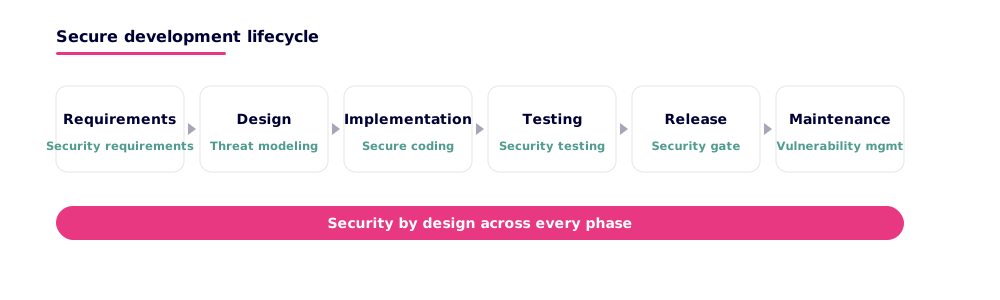
A secure development lifecycle (SDLC) is a development process in which security runs along in every phase: from requirements through design and threat modeling, implementation and testing, to release, maintenance and vulnerability handling. Instead of checking security at the end, it is a fixed part of the work.
Does this work with agile?
Yes. A good SDLC is method-agnostic. We adapt security activities to your rhythm, whether waterfall, Scrum, Kanban, DevOps or hybrid, so they are embedded in the way you already work rather than sitting next to it.
Do we need an SDLC for the CRA?
In practice, yes. For products with digital elements, the CRA requires a demonstrable, secure development process including vulnerability handling. For the regulatory framework, see CRA & Product Regulation.
Is the SDLC connected to IEC 62443-4-1?
Directly. IEC 62443-4-1 certifies exactly this secure development process. A lived SDLC is therefore the basis of a 4-1 certification. More on that under Approval & Certification.
How long does rollout take?
That depends on your starting point. After taking stock, you get a realistic roadmap with an effort estimate. We roll out step by step so the process lands in day-to-day work rather than gathering dust as a policy.
Did not find the answer you need?
Talk to us. We will answer it for your product and your development process, not in general terms.
Book a callGet in touch
Ready to bring security into the process?
Want your development process CRA- and IEC 62443-ready without slowing your teams down? In a short call we gauge where the process stands, name the key gaps, and lay out what to do next.
Book a free initial call
Fill in the form. We will get back to you shortly to arrange a short initial call.